
We can hope that some of the benefits of the rural spending - on irrigation, roads, etc -- will spur rural demand and improve rural productivity, says P V Subramanyam.

Retail investors have become a force to reckon with in the last 10 years with their ownership of Indian equities rising 800 basis points, or 8 per cent, to 23.4 per cent during this period, suggests a recent note from Morgan Stanley. This number, Morgan Stanley said, is set to rise in the next few years as Indian households are still underinvested in equities. India's demographics, policy framework, investor education and modest positive real rates, it said, will fuel the 'equity cult' in India.

Skilling of people to use new technology in manufacturing should be encouraged, said Sun Pharma MD Dilip Shanghvi

Prime Minister Narendra Modi urged CEOs of US majors to take advantage of India's growth story as the country is making all efforts to become the third largest economy of the world in his third term. India is currently the fifth largest economy of the world after the US, China, Germany and Japan with a GDP of around $3.9 trillion. India has been the fastest growing large economies of the world with GDP growth rate of over 7 per cent for the last three consecutive years.

A majority of CEOs from top Indian companies including ICICI Bank, Bajaj Auto, TVS Motor GE India, and HUL, do not foresee any production slowdown in this fiscal, even as rising input and interest costs are affecting the net profit margins, a CII survey has found.

Top companies across sectors -- automobile maker Maruti Suzuki, consumer electronics giant Samsung to IT giant Infosys -- have reopened factories and offices as India took its first steps towards resuming economic activity after weeks under a near-total coronavirus lockdown.

India Inc is encouraged by a determined Budget.
Corporate leaders said a stable government at the Centre will help boost infrastructure spend, address agricultural distress, and encouraging employment.

The NITI Aayog's vice-chairman's charge holds ground.

The report said forward-looking surveys and economic indicators along with rising business confidence provided hope that the decline in private corporate investment 'could be arrested' in 2014-15 and fresh investments of over Rs 1.2 lakh crore (Rs 1.2 trillion) 'could be realised'.

Fresh investments by corporates up just 5.8% in FY17, lowest since 1992
Stating that recent agriculture reforms have opened new opportunities, the RBI Governor said the farm sector is emerging as a bright spot.

The chambers said that the situation calls for urgent policy measures both by RBI and the government to salvage industry from further decline in industrial output.

Corporate India handed over an average increment of 8 per cent in 2021, and early estimates reveal that average increment for 2022 is expected to increase to 8.6 per cent in line with a healing economy and improving confidence, according to a Deloitte survey. As per the second phase of Deloitte's Workforce and Increment Trends survey 2021, 92 per cent companies gave an increment in 2021 at an average of 8 per cent, compared with only 4.4 per cent in 2020, where just 60 per cent companies had extended a pay hike. For 2022, average increment is expected to increase to 8.6 per cent, at par with the pre-pandemic levels of 2019, the survey said, adding that about 25 per cent companies surveyed have projected a double-digit increment for 2022.

Modi has often been accused of promoting crony capitalism in Gujarat for his proximity to certain businesses.

Dalal Street had a roller coaster ride in 2024 from shattering record after record to facing heavy correction off-late but equity markets still rewarded investors with positive returns, driven by a surge in domestic fund flows and a resilient macro landscape. The first half of the year saw robust corporate earnings, a surge in domestic flows, and a resilient macro landscape, driving the Nifty to an all-time high of 26,277.35 in September 2024, according to Motilal Oswal Wealth Management.

The forthcoming budget is an excellent opportunity for the Government to fulfill its promise of high economic growth.
Economic growth slipped to a nine-year low of 6.5 per cent last financial year, but India Inc fears further deceleration in the GDP expansion during 2012-13, shows a survey.

In fact, India's investment activity growth is also estimated to touch a 17-year low in FY20. With overall demand not showing signs of revival, investment activity may take longer to recover, economists said.

They say that a stimulus package may not be necessary because, unlike last year's total lockdown, public transport, including the railways and airlines, is running and the restrictions on movement are localised and, in some cases, are partial rather than total.

Buoyed by 8.8 per cent growth of the Indian economy in the first quarter this fiscal, industry on Tuesday said the GDP may expand by around 9 per cent during 2010-11, but cautioned against certain weak areas like financial services.
Declining GDP growth, persistently high consumer inflation, poor public finances and worsening macro-economic indicators. In such a scenario, should Indian companies chase growth or consolidate their market position?

Top companies in China are valued at 7.7 times the trailing 12-month earnings against a P/E ratio of 18.6 times for Nifty 50 companies.

Though the intent has been hailed as good for the economy, teething problems remain with a five-rate structure for various goods and services

A majority of corporate honchos feel that reviving India's overall economic growth to seven per cent will be feasible in the next fiscal, a survey by industry body Assocham said.

Boost to dairy sector will generate jobs

Research and development (R&D) spending by BSE 100 companies has grown steadily, rising from 0.89 per cent of revenue in FY20 to 1.32 per cent in FY24, averaging around 1 per cent over the period in-between, according to data compiled from Bloomberg and company annual reports. Also, these companies more than doubled their R&D spending in absolute terms over these five years: From Rs 25,041 crore to Rs 63,072 crore. While this reflects a prioritisation of innovation, corporate R&D investment remains relatively conservative.

Happy at the clear mandate given by voters to the BJP-led NDA, India Inc on Friday exuded confidence that Narendra Modi will initiate bold and decisive policy reforms to promote economic growth.
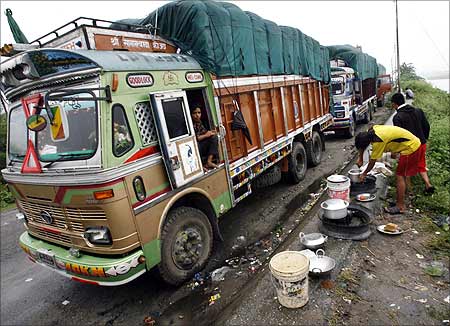
Implementation of GST is expected to increase the gross domestic product of the country.

India Inc said policymakers should take doable steps to revive fixed investments and production of capital goods

'As we enter 2025, it must be acknowledged that there is a convergence of capital, influential people (from business and politics) and technology deciding the destiny of others in the name of pride, patriotism, nationalism, nation building, all of it thinly veiled disguises for personal profit and glory,' asserts Shyam G Menon.

Bankers said the outlook of M&As in India in 2024, especially in the second half after the Lok Sabha election, seems relatively better.

'Historically, the markets tend to perform well during election years as governments aim to increase spending and call attention to growth.'

Opposition politicians on Wednesday stalled a last minute attempt by Prime Minister Narendra Modi's government to pass the Goods and Service Tax bill.
Capital expenditure by private companies halved in FY13 from that in FY08; households put more money into gold, houses.

India's latest GDP numbers do not signal robust economic growth in near term.

Search is on for reliable indicators of underlying activity.

The banking regulator was uncomfortable with the runaway pace at which consumer credit was growing.
 © 2026 Rediff.com - Advertise with us - Disclaimer - Privacy Policy - Sitemap - Feedback - About us - Terms of use - Grievances